Showing posts with label MRS. Show all posts

Wednesday, January 11, 2012

Mississippi River Skiff update: OarLocks

The pinion of the oarlocks are set 12.5 inches past the edge of the rowing stations.
This is the distance we find best for the stroke geometry in this hull.  If they are set farther abaft you get less reach forward with the oar.  Farther forward and it is too tight.
There is a lot of variation of opinion on the best distance, this is our opinion and our boat.


This weekend we will be sanding the interior to prep for varnish and working on the oars.
Here is a picture of the oar blanks (and a Greenland paddle).  The Ash and cherry look good together.

Saturday, January 7, 2012

Mississippi River Skiff update: out of the shop

Yesterday we moved the skiff out of the shop onto a trailer with the help of the visiting students.  The trailer came with our 14 foot Rhodes Bantam.  The Bantam is on blocks so we could use the trailer.

The only problem is the length of the skiff.  At 18 feet 3 inches it extends way past the end of the trailer but more problematic is the wheels are too far forward.

Today we are going to set the skiff on the ground and reconfigure the trailer.
We can move the wheels back about 2 feet.  This should balance things out.

Today we are also going to instal the oarlocks.  We found a set of four at the Nautical Consignment shop in Oriental, NC.  They are old galvanized locks that are in great shape.  I was looking for bronze, but  of course this skiff historically was a working boat on inland rivers and would have been fitted out with the most practical cheapest hardware available, so galvanized it is!
Finishing out the interior, then hull priming and paint


Thursday, December 22, 2011

Mississippi River Skiff update: lilly pads

Seats are edged with the black oak and installed.  We salvaged an old chair with nice turned legs.  Two of these are used as supports for the two rowing stations.

I like the Johnson Wax building by F.L. Wright, so we set the posts with the taper down like his lilly pads.
The Walnut base that was laminated to the sole of the boat is directly under the center of the seats.  We set a laser plumb on the base to find the spot to drill the seat.
This was marked, the seat was taken to the drill press and a forstner bit was used.  The depth was set at half way through the Walnut. 
Installed
Lilly pad
After both holes were drilled we measured for the turnings and cut them to fit.
Once everything fit tightly, an adhesive fiber epoxy putty was used.  Bronze fasteners will be added to the side blocks after everything hardens.

Sunday, December 11, 2011

MRS update: gunwales / seats

Yesterday we laminated the second layer of black oak to the gunwales.  Instead of epoxy, we used Titebond 3.  I am a big fan of 3.
It has a formulation that has more body to it when it is set.  It also has a dark brown color which disappears in joints.
After the the clamps were removed we went to work with the power planer to bring the gunwale into proper form.
It took about 15 minutes.  According to J Henry, you can't beat power tools.
Later we will dress the top with a sanding block and drill holes for the oar locks.

Tomorrow we will prepare to glass the interior's sides.  Before we start that we just had to see the boat with the seats in, so we cut walnut for the rowing stations.  They were set in and we had a short imaginary boat ride.
Before the seats are installed, both the leading and trailing edge of the rowing station seats will get a black oak trim piece.  The light color of the oak will look great framing the dark walnut.
Gunwale without exterior trim
After a little block sanding it will be ready for a round-over bit.

Walnut seat with oak trim piece

Friday, December 9, 2011

MRS update: hull interior

We glassed the sole and decided to install the seat supports before glassing the interior's sides.
Otherwise we would have ended up with secondary bonds on these stress points.
This will make the glass work more difficult but will yield a stronger boat.
Pieces of cherry were cut to the bevel and curve of the hull.
These were epoxied in place to support the two rowing stations as well as the large U shaped rear seat.

For the bow deck structure, we matched the size of the deck Chapelle indicated on the sailing version of this hull.
Instead of supporting a mast partner, this deck is for storage and a platform for sitting or standing.
It will be great boat for fishing.
A bulkhead of fir ply was cut and tabbed in place.
The deck lid will be removable.  This will be a lockable area and will hold quite a bit.
We are not planning on installing permanent floatation.  I would like the boat to look more traditional.  Instead we will have a removable floatation bladder in the bow deck and a bladder attached under the transom seat.

The gunwales are made of black oak.
We picked up a few boards yesterday.  This morning they were cut to half inch strips.  Their height is 1.25 inches.  Two strips will be laminated to make the gunwale on the interior of the shear.  The exterior piece will be cut and laminate later.
This thickness looks right proportionally and will allow enough room for the bronze oar locks.

Transom seat support

Here are the additional strips of black oak for the gunwales.

Bow deck enclosure.  The interior was glassed prior to the bulkhead installation.

Sunday, November 27, 2011

Mississippi River Skiff: update

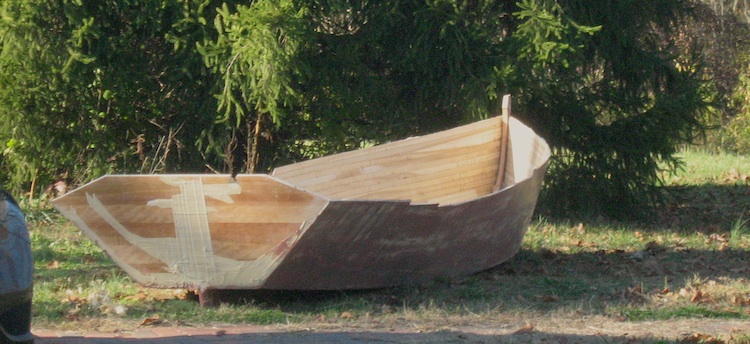
The exterior of the hull has been glassed, kevlared, and faired.
We removed it from the forms and got our first ever look at this hull form.  Are there any other Mississippi river skiffs of Howard Chapelle's lines out there?  It is on page 99 of his ASSC.
Let us know.
We like it.
The hull was stripped above the shear.  The plan is to cut the shear after all the glassing is finished.
The strong back is being taken apart and removed from the shop.
We will get the hull back inside and begin sanding the interior and prepping for the interior glass.
Next, we will be forming the thwarts, seats, and bow deck enclosure.


Tuesday, November 15, 2011

Mississippi River Skiff update:

We just glassed the MRS.  After a final fairing and sanding, we glassed the hull with 9oz glass cloth set in low viscosity Raka epoxy with a slow hardener.  This gave us plenty of time to roll out all the wrinkles with a ridged roller.
After three hours we gave it a thin fill coat to fill in the weave.  After another three hours had passed, the surface was slightly tacky and we rolled out the pre cut Kevlar for the bottom.  This received the same epoxy treatment.  It was then three am. so we called it a night.
9oz cloth, originally 50 inches wide, cut down to overlap on the centerline.

The skeg has a 3/4 inch fillet for strength and to ease the layup.  The glass laps in both directions.

The Kevlar bottom will allow for some rough landings.

Wednesday, October 12, 2011

Mississippi River Skiff: Skeg

We have given the hull it's first course sanding (40 grit).  At this stage we are setting the skeg.
According to Howard Chapelle's lines, it should be 6.5 inches at the stern and taper to 0 before station number eight.
Instead of a single piece of wood for the skeg, we are building it up of poplar strips.  The first couple layers are 1 inch wide and then they drop down to 3/4 s of an inch.
The strips are set in colodial silica thickened epoxy.  Several layers of kevlar will end up on the skeg.


Sunday, September 25, 2011

Oars for the Mississippi River Skiff

Having never made an oar before we referred to Shaw and Tenney's beautiful oars for inspiration. On their excellent web site they indicate how to calculate the proper length of an oar for given row boat's beam.

Howard Chapelle's lines taken from an 1870's vintage river skiff indicate a maximum beam of 58.5 inches.  Taking this number and Shaw and Tenney's formula we arrived at 8.9 feet as  the proper length for the oars.

After sorting through our stacked lumber we finally found the ash boards.  (Rough cut ash and poplar look a lot alike.)  One of our two boards was not straight enough for oars so we were only able to cut three blanks.  This gives me a reason to call John again and get back to the lumber yard.

The blanks are cut to 1 & 3/8 ths inches square.  The next step is to order a larger round-over bit for the router. We are looking forward to making these oars.

The ash is sailing through the table saw.
Once you have a clean cut on it, it is a very familiar looking wood,
(every wooden baseball bat you have ever seen).

Monday, September 12, 2011

Mississippi River Skiff construction


Since the bottom of the Mississippi river skiff is "flat"  (it bends through only one plane,) is was super fast to finish.
Because of this we could use wide planks. The planks are 4.5 inch wide ship lapped cedar planks.
They are 5/8ths thick. We started with the bottom and are working down to the gunnels.
After the new poplar had thoroughly dried we planed the strips down to 3/8ths of an inch thick and started the hull's sides.  Working down on the form is different.  It is the opposite of our past projects but for this boat it is working well.
We are using edge clamps to press the strips together and additional clamps to keep the strips tight to the form.  The size of the boat meant it was going to require a trailer from the start.  This lessened the weight considerations and freed up up our choice of materials and thicknesses.  The transom is an attractive shape and we are going to cut it out of a cherry glue up.  It will be an inch thick.
The first hull we build will be set up as a row boat with two stations per the plans.  But the transom will be engineered to take the stress of an outboard.  This is always wanted around here. 
A sail version could be next.


A plumb bob is used to make sure the bow is not pushed out of alignment as the sides are built.
The bob is about 150 years old, and it still works!


Wednesday, August 17, 2011

Mississippi River Skiff

We are making great progress on the Mississippi River Skiff stations.  It will be our biggest boat to date at over 18 feet.
After our experience using steel stations for the Niangua canoe, we knew the advantages of the steel forms made it worth all the trouble to fabricate them.
For our next boat we were looking for something native to our waters and fell in love with Howard Chappelle's Mississippi River Skiff.   He took lines off a 1889 working wooden boat.  It is on page 97 of his excellent book  American Small Sailing Craft.
Here are the stations during fabrication:

Paper work: we are converting the offsets to inch measurements.  Also we are using some trigonometry to figure the length of the station from the chine to the shear. Click on the image for a closer look.


Here the stations have their centerline and are ready for a coat of acrylic spay to keep them from rusting.


The cherry chine forms are used to narrow the face of the station to accept the bending wood without deflecting it under clamp pressure.

The next posting will show the shape of the hull as the stations are spaced on the strong back.