Wednesday, August 17, 2011

Mississippi River Skiff

We are making great progress on the Mississippi River Skiff stations.  It will be our biggest boat to date at over 18 feet.
After our experience using steel stations for the Niangua canoe, we knew the advantages of the steel forms made it worth all the trouble to fabricate them.
For our next boat we were looking for something native to our waters and fell in love with Howard Chappelle's Mississippi River Skiff.   He took lines off a 1889 working wooden boat.  It is on page 97 of his excellent book  American Small Sailing Craft.
Here are the stations during fabrication:

Paper work: we are converting the offsets to inch measurements.  Also we are using some trigonometry to figure the length of the station from the chine to the shear. Click on the image for a closer look.


Here the stations have their centerline and are ready for a coat of acrylic spay to keep them from rusting.


The cherry chine forms are used to narrow the face of the station to accept the bending wood without deflecting it under clamp pressure.

The next posting will show the shape of the hull as the stations are spaced on the strong back.

Sunday, July 24, 2011

Paddle Delivery

The four best paddles were delivered to St. Louis Sail and Paddle last week.
We have about six more in line for varnish.
This week we are welding up the station forms for our next boat project. Stay tuned.
Here are the paddles...


Saturday, July 9, 2011

Ebonized wood

The current batch of paddles are made of Cherry, with accents of Santos Mahogany, Redwood and Western Red Cedar.  In past projects we have used the Amish trick of staining Cherry with white vinegar with steel wool dissolved in it.
This mixture goes on clear and within minutes turns the wood black.  It is like tray developing a black and white photograph.
It works great with Cherry and as we found out today, also works just as well with these other woods.
After two coats of the mixture to even out the stain effect, we let the paddle dry thoroughly.
At this point it has a flat dusty finish.  This is wiped down and it is ready for top coating.


Tuesday, June 28, 2011

Night work

We are working on standards and methods to give our paddles some amount of uniformity.
Uniformity is probably the wrong word at this point.
We just want them to look like cousins.
To that end we are cutting parts in series.
For the next 25 paddles, we are using some Santos mahogany for the handles.
The parts are cut in matching sets, taped together until the glue-up.
The same process is followed with the blades.
Because of the width of the blades there is the opportunity to book-match the grain or at least find complimentary stock.

Friday, June 24, 2011

New paddles


We are back in the paddle business this week.  Three blanks were glued up and here are some of the results:


 The paddle bench is a tall saw horse of steel legs and a hardwood top.
It really speeds things up.

Sunday, June 19, 2011

Cicadas and boats

Cicadas really like boat building.  Who knew?


Or it could be the dust and vibration.

Saturday, June 18, 2011

The spar lathe

Today we took the spar glue-up for a spin on our spar lathe.
To speed up the milling and keep it round we incorporated an old device.
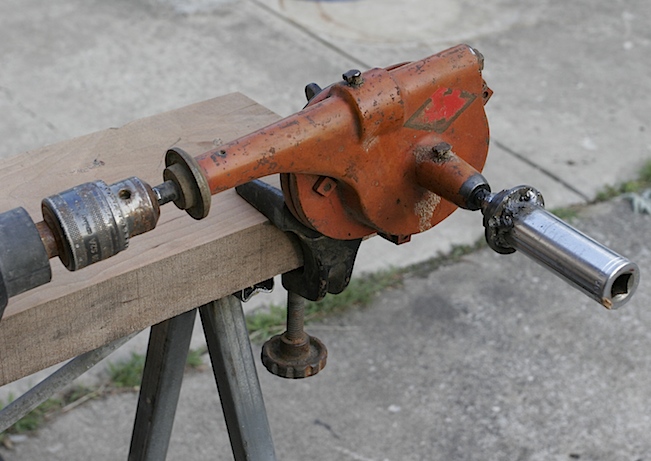
Long ago I picked up a bench mounted, hand powered grinding wheel.
I imagine it is from the thirties.  If you can find one in a junk shop, grab it.  It is compact, well made and cool looking.  When not in use, the lathe parts could fit in a shoe box.
After removing the handle, we turned it around so it acts as a reduction gearing.
I then welded up a couple of chucks.
By adding an adjustable clamp on a variable speed drill, we have a slow turning lathe.  It is perfect for a rough pass with an angle grinder, then progressive passes with an orbital sander.

Here, Frank (aka Fabulon) is working on the glue-up.  The two of us use ten large hose clamps and finish this step in fifteen minutes.

Josh is seen here working on the 40 grit pass with the orbital sander.  In the foreground you can see the gearing.
The far end of the mast is supported by a small work stand you can't even see.
Click on the photo for a larger version.
This is the device. 
A socket that fit perfectly in the hollow of the mast has found a new job.

Wednesday, June 8, 2011

Spar Jig

This past weekend we built a spar jig to cut bird's mouth cuts.
Our plan for the sailing canoe is to fabricate a mast of about three inch diameter.
To do this we ripped an eight quarter chunk of Cherry on a forty five.  The two halves are screwed together with aluminum stock.  Then a slot for a dado blade was ground in.
Our lovely clear Douglas fir boards are then ripped to 9/16 ths and then run through the jig.
Pictures might be clearer than my description...


Here are enough staves for our mast and maybe a spare boom.

Monday, May 30, 2011

the ama is coming along.

I inserted 4 ply bulkheads.  The pylons are set in a cedar shoe.  A forstner bit was used to make a secure base.  Then the pylon shoots up through a stringer that is epoxied in.
The interior is epoxy coated and will get closed up next.


Saturday, May 21, 2011

Ama for the sailing canoe:

Today we cut up steel and brazed it to create station sections for the sailing canoe's ama.
We had some nice radius 1 inch square tube.  It has been sitting around awhile and we finally found a use for it.


The hull is being strip built of 1.5 inch cedar strips and will be about 11 feet long.
The strips are cut to 5/16ths or there abouts and run through the Red Fox!
This is fun:


Monday, May 16, 2011

My machinist friend, Charlie C.

Charlie at Industrial Machine is a fantastic fellow who is saving some serious iron from the scrap heap.
In the corner of his shop on Broadway, he pointed out this fantastic 1937 Red Fox bench planer.
It looks like it was barely used and stored well.
Snapped it up, and he has a 1920's Crescent 32 inch band saw we are reworking.
Look at this...


Saturday, May 7, 2011

The bantam is a fantastic boat!

August Curt and I took out the Rhodes Bantam for a test sail on tiny Beaver Lake in Southern IL.  The Mississippi is too high and fast to try without a motor.
I really like the lines of the Bantam.  I used to not like chines esthetically, until I sailed this boat. The chines perform a great function, digging in.  They give boats stability when heeled.  The boyancy in the chines angular shape resists heeling when a curved hull will keep rolling.
The boat accelerates really fast with very little wind.
This boat needs a couple modifications.  The non original tiller handle is way too long.
The boom is a plank that is unnecessarily low in the cockpit.
Here are some dockside pics:


This is the mast base in action.
It works great but you have to be careful when handling the mast.  You don't want it to pop out when setting or striking the mast.

Thursday, April 7, 2011

Sail track / seal coat

The mast off the Bantam got a through rub down (the sandy kind) and a sealing coat of epoxy.  After a few days I will start the varnish cycle for the uv protection and beauty of it.  Then there will be the rigging of the mast.
The sail track is a routered in recess for a boltrope.  We shall see how freely the sail travels through it.  Hopefully soon.


This is the all purpose work bench in action.

Monday, March 28, 2011

Spar work

Sanding and refinishing the spar off the Bantam.
This spar is a very straight lamination of two pieces of fir.

I'm sure this has been done before, but I've never seen it.
A tow ball hitch was used as a base for the mast.
A pipe section is used as the receiver.
Clever.

Thursday, March 3, 2011

New Company Boat!

Good old boats have nine lives.
This 1960's vintage Rhodes Bantam class 14 footer turned up on Craig's List.
It is in great condition and was obviously from a good home.
We can't wait to dip it in the Mississippi!